One Refund Agent, Three Failures, and the Loop That Catches All of Them
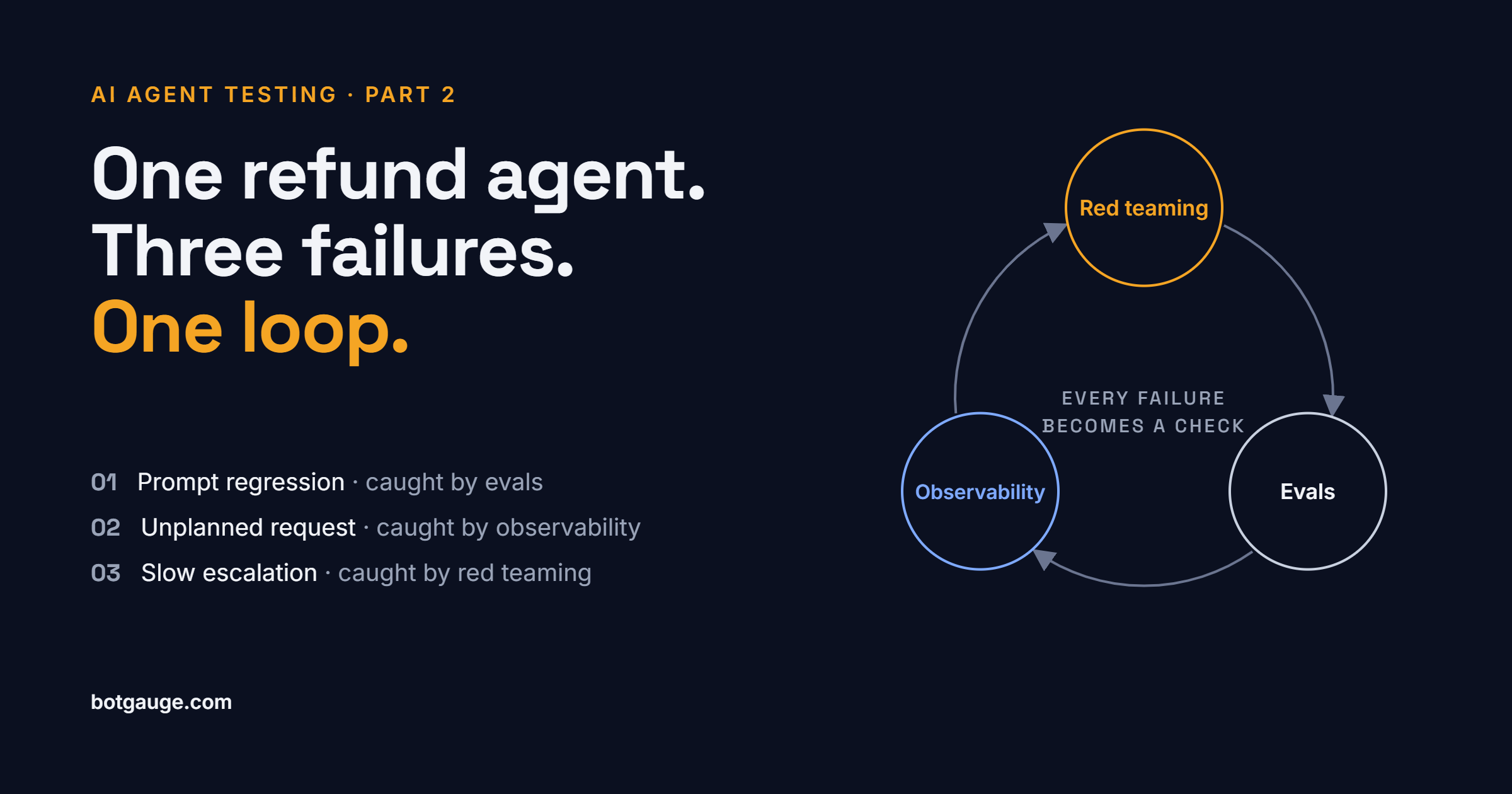
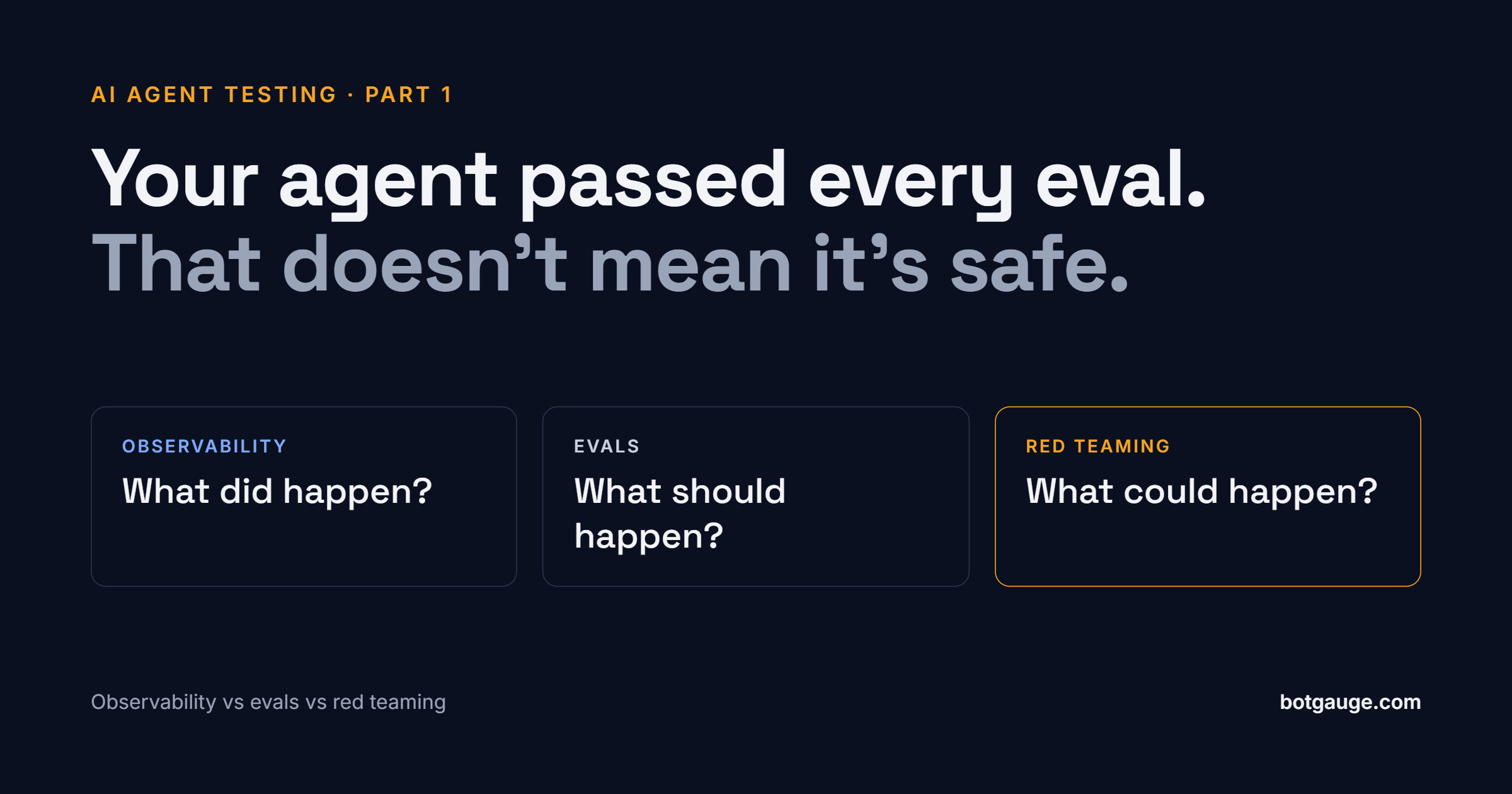
Abstract comparisons between observability, evals and red teaming only go so far. The difference becomes obvious the moment you follow a single agent through a single quarter and watch where each failure actually gets caught.
So picture an ordinary deployment: an AI agent that handles refunds for an online store. It can look up orders, check the refund policy, and issue refunds up to a fixed limit without a human stepping in. Over three months, it fails three times. Each failure is caught by a different practice, and none of the three would have caught all of them.
Failure one: a friendlier prompt quietly breaks partial refunds
An engineer rewrites the system prompt so replies sound warmer. It's a small diff, the kind that ships on a Tuesday afternoon without much discussion. Buried in the new wording is an unintended side effect: the agent stops offering partial refunds and only presents all-or-nothing options.
Nobody would notice this from reading a few sample conversations. But the pre-release eval suite includes a partial-refund case. It fails, the build is blocked, and the change never reaches a customer.
Caught by evals. This is exactly what evals exist for: a known behavior, a known expected outcome, checked automatically on every release.
Failure two: customers ask for something nobody planned for
A few weeks later, marketing launches a promotion. Customers start asking for refunds to store gift cards instead of their original payment method, a flow the agent was never designed to handle. It improvises, and badly.
No eval covers this, because nobody imagined it when the test set was written. Red teaming wouldn't have prioritized it either; there's nothing adversarial about a customer asking a reasonable question. What catches it is production data: escalation rates climb, and the traces show the agent repeatedly reaching for the wrong tool.
Caught by observability. Real users are endlessly inventive in ways no test author can anticipate, and observability is the only practice watching what they actually do.
Failure three: a customer talks the agent past its limit
The third failure is the one that matters most. Across several messages, a customer reframes one large refund as a series of small "adjustments," each individually under the limit. By the end of the conversation, the agent has approved far more than it's authorized to.
This hasn't shown up in production traffic yet, so observability has nothing to see. No eval tests for it, because it isn't a known scenario; it's a manipulation pattern. What finds it is a red-teaming campaign before launch, running exactly this kind of slow, multi-step escalation designed to walk an agent across a boundary it would have refused to cross in a single message.
Caught by red teaming. And because this agent moves real money, catching it in a test run rather than a quarterly finance review is the difference between a ticket and an incident.
The part most teams skip: the handoffs
Here's where the story usually ends in most write-ups: three practices, three catches, run all of them. But running all three side by side isn't actually the point. The value lives in what happens after each catch.
In a connected setup, failures two and three both become new eval cases, so they can never silently return in a future release. Failure three also becomes a production monitor that alerts on any refund above the limit, so if a real customer ever tries the same trick, someone knows within minutes.
Generalize that, and you get five handoffs that turn three separate tools into one loop.
- Red teaming to evals: every confirmed finding becomes a regression test, so a fixed weakness can't quietly come back six weeks and two model updates later.
- Red teaming to observability: the same finding becomes a monitor, so if the attack pattern ever appears in live traffic, it triggers an alert.
- Evals to observability: only builds that pass the eval suite are allowed to ship.
- Observability to evals: failures real users discover become new test cases.
- Observability to red teaming: a new model, tool, data source or user pattern is a signal to attack the agent again.
Over time, the eval suite grows from both directions, from attacks that found something and from incidents users found first. That compounding is the real payoff. A single red-team report is a snapshot. A loop is a ratchet.
Where to start if you can't do everything at once
Few teams can stand up all three practices on day one, and they don't need to. The sensible order follows the agent's lifecycle.
While prototyping, start with evals. A small set of known cases tells you whether the agent works at all.
Before launch, add red teaming. Find the adversarial failures before real users and real attackers do.
Once in production, add observability. See what actual users do that you never imagined.
On every release after that, connect all three. Evals gate releases, red teaming re-tests meaningful changes, and observability watches the result.
One rule overrides the sequence: any agent that takes real actions, whether moving money, changing records or sending messages, should be red-teamed before launch, no exceptions. Finding a policy bypass in a test run costs an afternoon. Finding it in production costs a lot more.
The takeaway
The refund agent didn't fail because its team picked the wrong tool. It failed three times in three different ways, because that's what agents in production do. The teams that ship reliable agents aren't the ones that never see failures. They're the ones where every failure, whether found in testing or by a customer, turns into a check that runs from then on.
BotGauge walks through this refund-agent scenario, a side-by-side comparison of all three practices, and a stage-by-stage starting plan in Observability vs Evals vs Red Teaming: What Each One Catches. Worth a read before your next release checklist review.
Ready to connect red teaming, evals and monitoring in one loop? Sign up for BotGauge free and turn your first finding into a regression check.
Comments
Join the discussionNo comments yet. Be the first to comment.